by Alexander Welscher, Baltic Business Quarterly, autumn 2024
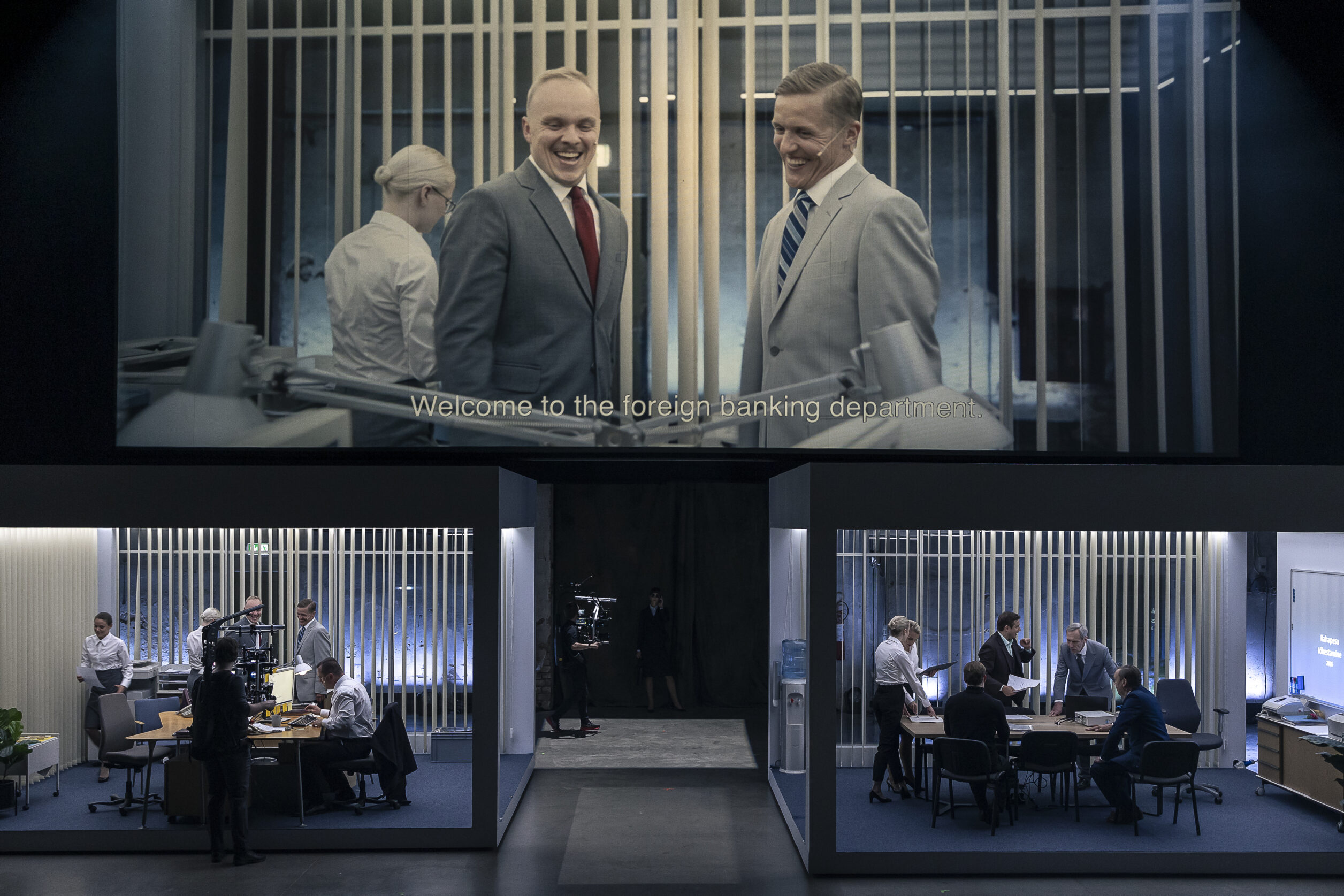
Brilliant, entertaining, intriguing: Inspired by the huge money laundering scandal that rocked the Estonian banking system a few years ago, the Estonian Drama Theatre has put a straightforward story on the stage. “Business as Usual” is an all-encompassing theatrical experience.
It was one of Europe’s largest ever moneylaundering scandals: Some 200 billion euros in suspicious payments flowed through the nonresident client portfolio, of the now-defunct Estonian branch of Danske Bank, between 2007 and 2015. The funds, of dubious origin, were moved through a widespread network of shell companies and ultimately ended up in various accounts around the world. The massive scandal hit the headlines a few years ago and not only led to investigations and civil litigation claims against Denmark’s largest bank in several countries, but also cast a shadow over the financial system that acted as a gateway for the dirty money into the European financial system.
What happened in Estonia has kept the general public, policy makers, financial authorities and the courts busy for some time. Not least because of the vast amounts of money involved: The total of around 9.5 million payments that flowed through Danske’s tiny branch was almost equal to Estonia´s GDP in the nine-year period under scrutiny. Six former employees are currently on trial over the money laundering scandal – their trial in Tallinn began in November 2023 and is expected to continue until mid-October 2024. The former head of the branch committed suicide in 2019.
Welcome to Moneyland
Inspired by the scandal and the personal dramas involved, the Estonian Drama Theatre has taken on a play about the money laundering scheme that was staged in June in Tartu as part of the European Capital of Culture 2024 programme. Titled “Rahamaa” (Moneyland) in Estonian and “Business as Usual” in English, it was performed a total of eleven times at the Tartu Kammivabrik (Comb Factory), and was accompanied, at the venue, by seminars and experts talks on the nature and dangers of money laundering and its impact on the economy and other areas.
“On the one hand, financial issues are complicated and certainly not the sexiest world for theatre at first glance, but on the ohter hand: big money sets big wheels in motion, and therefore it is still a very important topic that affects us all,” director Hendrik Toompere jr. told Estonian media ahead of the premiere on 6 June. “What happened in Estonia is not an exception, but a universal example of the off-shore world of banking.”
Dealing with money laundering in an artistic way is not an easy task and is a brave undertaking since it is usually a white-collar crime carried out as back door business in corporate or office settings. But the team around Toompere jr. and play author Mehis Pihla have succeeded in creating a modern, multi-dimensional piece worth seeing. Staged in a large abandoned industrial building, “Business as Usual” is a masterfully plotted financial thriller in a narratiive style with wit and pace that is special and impressive in terms of its technical execution and the great performances of the actors.
Win-win-no shit-scheme
The tale, at its core, revolves around one young man named Artur from the Tartu suburb of Annelinn, whose post-Soviet desire to get rich turns him into a money-obsessed person taken in by the lure of lucre and the power of prestige. After making a living with odd and occasional jobs, he – through an acquaintance from his hometown with the same biography – ends up working in the foreign Banking department of a prestigious capital bank in Tallinn. The department’s primary clientele are Eastern Bloc oligarchs, to whom it caters flexible and secretive financial services.
“Our bank is as solid as a ‘swissarskaya’, as close as a ‘peterburgskaya’, and as confidential as an ‘offshornaya’. If Nokia is ‘Connecting People’, then we’re ‘Connecting Dollar’,“ is how Artur and his colleagues are advertising their services to their wealthy clients in the play. “We’re cheaper, always online, and available in Russian. We provide a full service. Exchange into euros, into dollars, and if you need it, then in cash and straight home to Rublyovka. Total privacy guaranteed.“
The business is thriving and grows to become very lucrative – the number of clients and the turnover of the department is skyrocketing. Everyone seems to know that money laundering is involved, but no one cares – it is part of the job. Money is the most important thing – morality, dignity or ethical considerations are simply put aside.
“You know what this scheme is called? Win-win-no shit. I win, the bank wins, and the client has so much money that he doesn’t give a shit as long as it’s moving,” one colleague of Artur stated in a scene.
“The fact that we were poor is to blame for everything”, Artur himself has repeatedly said to explain the mad obsession to be rich and successful for which he is ready to do anything. He finds himself entangled in a world where he must navigate encounters with oligarchs, thugs and the demimonde, and experiences decadent adventures at parties in luxurious resorts across Europe and the vast expanse of Russia. All of which must be balanced with his private life and the paranoia resulting from the increasing pressure from the financial authorities.
Box office and critical smash
Starting out in the mid-1990s, the play essentially, or at least to a certain degree, symbolises the story of an entire generation and its path to a bright future, revealing many characteristic features of Estonians, the country and its recent history.
“We are here on the border of two worlds. On one side is crazy Russia, on the other side is prosperity and the West. And then there are we who are moving away from the Soviet Union to the West. It creates an interesting tension field to deal with, along with poverty to climb out of”, Toompere jr. said.
Based on documentary material and personal interviews with bank employees the play not only presents the recent history of money laundering and the case of Danske Bank’s Estonian branch, but also tries to map the mindset of the money launderers and the reasons for their choices. All of this has been seasoned with dark humour and put on the stage by an excellent ensemble before and behind the scenes that successfully blends the genres of theatre, film and music in a gripping production.
“Business as Usual” has been a hit in Estonia. The sold-out performance attended by Baltic Business Quarterly received standing ovations with long, enthusiastic applause. Theatre critics have also been very positive about the three-and-halfhour long play, while on social media it was even praised as an unprecedented production in Estonian theatre. As unprecedented as the money laundering scandal.
Lavastuse lehele →