Draamateater newspaper, autumn 2025
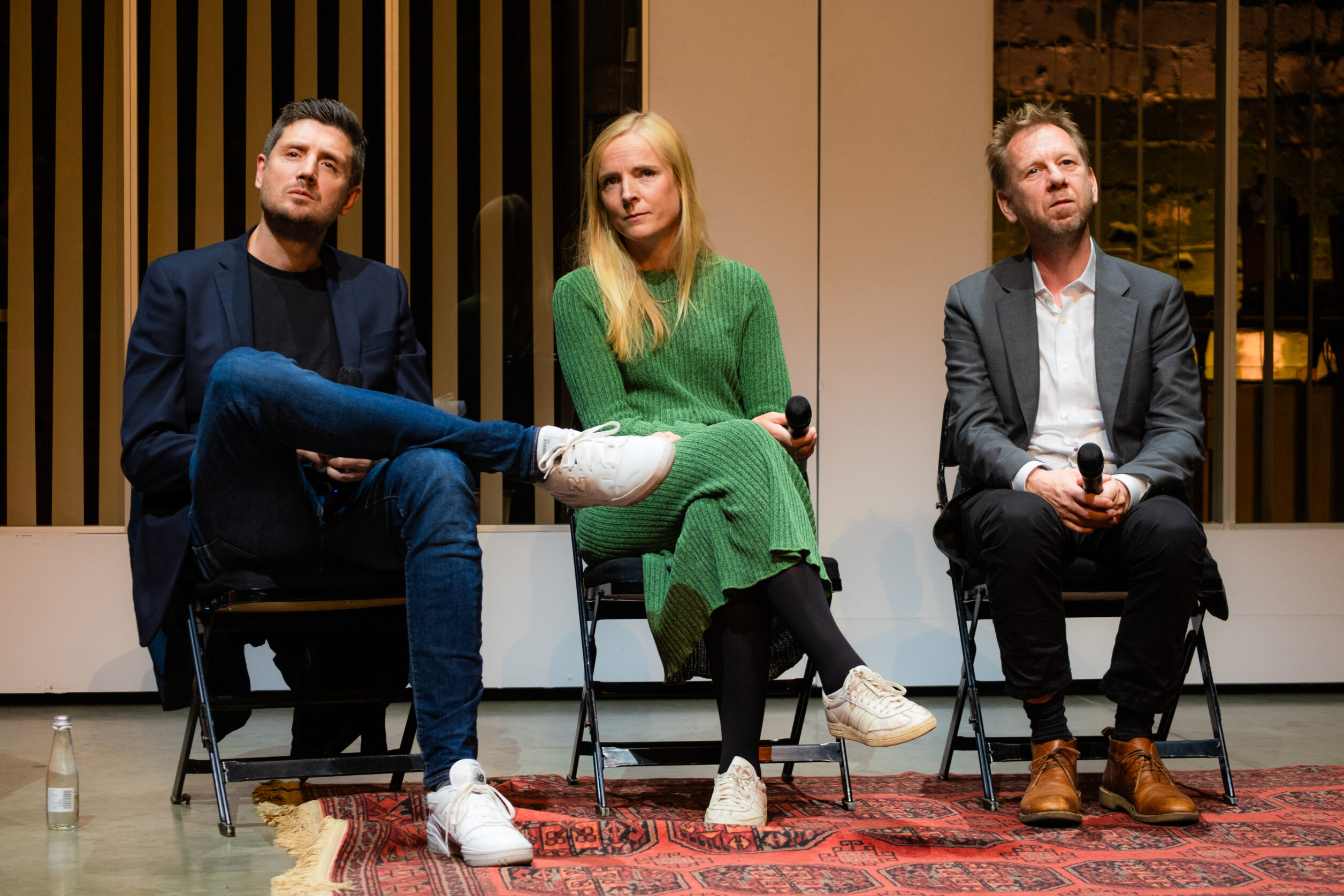
On 17 September, the performance of „Business as Usual“ was attended by investigative journalists from Denmark: Eva Jung, Michael Lund and Simon Bendtsen. They were the first journalists to report on the Danske Bank money laundering case. After the performance, the audience had the opportunity to talk with them as part of the Link event series. The conversation was moderated by Mehis Pihla, the author of „Business as Usual“.
Mehis Pihla: Let’s start with the most important question. Was Kersti Heinloo’s Danish understandable?
Michael Lund: If you mean her Danish pronunciation, then yes, we understood it. (Laughs.) But speaking of the production — I think we all agree — it was extraordinary! It was fascinating to see how something that began with us going through pages and pages of boring bank transactions has become such a gripping story on stage.
Simon Bendtsen: We were just saying that the production may have set the bar too high for our conversation now.
Mehis Pihla: Did you recognise the story? Were the facts accurate? Did you learn anything new?
Eva Jung: It was very funny to follow the different references to what happened in real life. For example, the story of the Russian Central Bank director, the mention of Putin’s cousin, the bond loops and the various transactions… I think you created a very vivid frame around what really happened.
Simon Bendtsen: For me, being here in this room tonight was very special, because for the first time we saw and experienced what it may have felt like for Estonians at the time, and how the story affected Estonian society. We did visit Estonia a few times, but only now did we understand how great an impact this had on Estonia. Danske Bank made a significant move when it called this “an Estonian problem”, rather than “money laundering”, as we treated it at the time. They distanced themselves very skilfully: this was something that happened in Estonia, not in Copenhagen. The production brought out that aspect very well.
Mehis Pihla: But how did the same scandal unfold in Denmark?
Michael Lund: It is important to point out just how much influence Danske Bank has in Denmark. There is no country in Europe, or in the Western world, where a bank is this large in proportion to the size of the economy. It was a huge scandal. It shocked many people. Of course, there were consequences: the entire management board had to leave, the bank had to pay record-breaking fines, and the children of the bank’s CEO even changed their surname.
But the production raises the most important part of what happened. The ones who were found guilty were the middlemen who set up shell companies on behalf of criminals and the bank — not the banks, the financial supervisory authorities or the politicians. Those who held the power and the money remained almost untouched, while the lower-level employees received the harshest punishment.
Mehis Pihla: There is a rumour in Estonia that the head of the Danish Financial Supervisory Authority was a member of Danske Bank’s management. Is that true?
Michael Lund: Yes, that is true. Henrik Ramlau-Hansen was Danske Bank’s CFO for many years. He was also responsible for the bank’s legal affairs before he became chairman of the board of the Danish Financial Supervisory Authority. That is how the system works in Denmark. People in this field are so tied to their own world that they can no longer get out of it. Today people say that Denmark has the lowest level of corruption in Europe and in the whole world… (Laughs.) But if someone from the management of Denmark’s largest bank can move straight to the board of the Financial Supervisory Authority in order to oversee banks, then that is obviously a major problem.

Following the Money
Mehis Pihla: Could you now explain how you discovered the money laundering at Danske Bank and how it became a scandal?
Eva Jung: It all began in January 2017, when our colleague in Romania told us that he had access to a large amount of data. It consisted of many bank transactions connected to money laundering scandals in Latvia and Moldova. Since some of the transactions reached Denmark, it was thought that this might interest us. At first, there seemed to be very few transactions coming into Denmark, but then, just in case, we asked to see the transactions directed to the branches of Danish banks — and suddenly the volume was enormous. Money connected to the Latvian and Moldovan cases had moved through the Estonian branch of Danske Bank. Everything pointed to money laundering. Money was being sent very rapidly from one company to another and then on again; the explanations for the transfers did not match the companies’ official areas of activity at all… Very large sums were involved. When we asked about these transactions in Denmark, we were told that they were aware of the problem, but that it was an Estonian problem and steps had already been taken to resolve it. As if that were the end of it and the case was solved.
Audience: In your opinion, were the lower-level employees, the client managers, ultimately guilty, or were they simply doing their job?
Michael Lund: That is a good question — who should be held responsible for the activities of Danske Bank’s Estonian branch. The short answer is that everyone is guilty. The client managers, too, because they enabled and facilitated illegal transactions that broke several anti-money laundering rules in many countries. The management of the Estonian branch is also guilty, because they either actively participated in this activity or turned a blind eye. Next, of course, comes the management of Danske Bank in Denmark and the officials responsible for oversight, because they too — like the Estonian branch — either turned a blind eye to several warning signs or actively participated in the same activity. So at every official level, there is someone to blame. In the end, both the Estonian and Danish financial supervisory authorities are also guilty, because they failed to stop the illegal transactions in time. All of this together created the perfect scandal.
Audience: Have you investigated what has happened in banking since Russia attacked Ukraine?
Michael Lund: Danske Bank’s transactions between Estonia and Russia ended in 2015–2016, when the Estonian branch was closed. But when the money left Danske Bank accounts, we saw that it moved to other banks. Since Russia’s attack on Ukraine, it is certainly much more difficult for Russian money launderers in Europe, but these money flows have probably moved to Central Asia, China and the Middle East. Cryptocurrencies will definitely be the next major issue in money laundering schemes. I am absolutely certain that Russian oligarchs and the Russian mafia — and, in fact, mafias all over the world — are still laundering their money, and unfortunately doing so very successfully.
Eva Jung: One funny moment in the production was the scene where the client managers were asked to close the clients’ accounts. That also happened in real life. There was a list of accounts in the non-resident portfolio that had to be closed. But in reality, clients were given the opportunity to move their money before the accounts were closed.
An Estonian Problem
Audience: Did the attempt to label the scandal as “an Estonian problem” succeed in Denmark? Do ordinary people think of it as “an Estonian problem”?
Eva Jung: Definitely not. We did everything we could to make sure it did not succeed. The Danish Language Council chooses a word of the year every year. When the scandal grew, the chosen word was “money laundering”. At the time, even our Queen Margrethe II mentioned the money laundering scandal in her New Year’s speech. So I do not think anyone except the Danske Bank management at the time calls the scandal “an Estonian problem”.
Michael Lund: But they still call it that, and it has become a big joke for the entire public. (Jokingly.) That is how communications people in large banks work.
Audience: The production repeatedly mentioned that operating with non-residents saved Danske Bank during the 2008 financial crisis, and that the client managers therefore called themselves the saviours of the Danish state. Is this a dramatic exaggeration, or is there some truth to it?
Michael Lund: I would say it is a dramatic exaggeration, but at the same time… This small Danske Bank branch in Estonia made up less than one per cent of the bank’s total turnover, but generated more than 10 per cent of its profit. Clearly, the Estonian branch was an extraordinary money machine. That was also our main question — why did no one at the Copenhagen headquarters ask what they were doing there in Tallinn to make so much money? (Laughs.) And why are we not doing the same in Denmark, if it is so successful?
But no, the Estonian client managers did not save the bank. Danish taxpayers saved the bank twice during the financial crisis, which in my opinion is also why Danes felt betrayed and became angry about the whole money laundering story. Because at the same time as people were giving Danske Bank 30 billion Danish kroner, Putin’s money was being laundered through that bank. Absurd.
Audience: How did you gain access to the transactions that were made? Who entrusted you with the data?
Simon Bendtsen: After the first stories were published, several anonymous sources contacted us. We received tips, we met people, including in Tallinn. People shared materials with us that they were not supposed to share, but they trusted us and they wanted this matter to become public.
Eva Jung: We did everything we could to protect the anonymity of our sources. In many cases, these people could be fired or sued. In this case, however, people were afraid to talk to us because of their clients. As the production also mentions, these were Russian oligarchs and people close to Putin… For example, we had one source in Estonia who told us that two men appeared outside the Tallinn branch, claiming to be lawyers and saying that they wanted some closed accounts reopened. Our Estonian source said that when he saw their hands, he immediately understood who they were, because when you have grown up in Tallinn, you recognise what FSB men look like.
Denmark’s Self-Image and Its Blind Spots
Maria Faust: I had the honour of writing the music for this production, but I have also thought a great deal about these subjects before. I am going to ask a slightly sharper question now, and I apologise in advance. Estonians are direct.
In the production, there is a scene where Jaanus and Artur stand at the bar and discuss how the Danes are modern-day colonialists. I have lived in Denmark for 23 years. I used to live in Esbjerg. (Laughs.) I know how money smells in Esbjerg… At the same time, Danes think of themselves as a small fairy-tale nation. Things always go a little better for them, because they have a better life and a better past, nobler values… How do you see it — how do this fairy-tale self-image and colonialism fit together in Danish society?
Michael Lund: That is a good philosophical question, and I do not have an answer, but I do have an opinion. I agree with you. In the Scandinavian countries, including ours, people have a very high opinion of their values. In general, we have a very high opinion of ourselves — there is no corruption, we are decent people, we behave properly, our largest companies say only the right things, we have firm rules about child labour and pollution. But for some reason, that only applies in Denmark. When we are elsewhere in the world, those values are nowhere to be seen, as we saw with Danske Bank. Carlsberg pollutes with its factory in India, pays bribes to politicians, child labour is used in China. The same pattern is repeated with other major Danish companies. The Swedes have exactly the same problems. At home, there are high standards and morals; abroad, nothing. So I agree with you: there is a clear contradiction between how we think of ourselves and how we actually behave. How can those two sides be reconciled? As a Dane myself — I do not know.
Simon Bendtsen: I actually have a short answer to that. Free and critical journalism. Issues like the Danske Bank case must be brought into the public eye. In the Danske case, it is not just about one greedy man or woman. It is a broader social pattern, both in your country and in ours. Public and free debate, freedom of speech, a critical mindset — these are crucial if we want to move forward. In fact, they are the only possible way.